
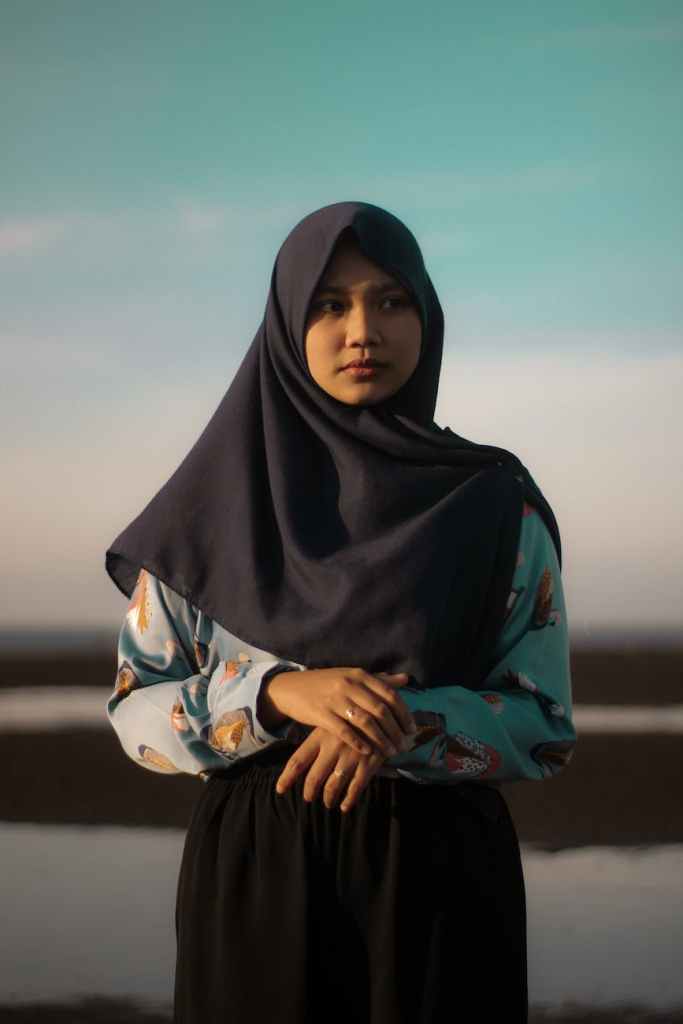
The hijab, a traditional head covering worn by Muslim women, has long sparked interest, discussion, and misperception. To determine if the hijab is primarily a cultural practice, a religious conviction, or a blend of the two, this project will critically explore each. We will understand the complicated nature of the hijab and its role in modern society by diving into historical, religious, cultural, and personal components.
Defining the Hijab Provide a detailed definition of the hijab, including all variants in head coverings, dress, and modesty practices. This will allow us to comprehend its intricate character. Although the practice of wearing a headscarf is firmly established in Islam, it is not stated in the Quran but is described in the Khimar.
Verse 59 of Surah Al-Ahzab, states, “O Prophet, tell your wives and your daughters and the women of the believers to bring down over themselves of their outer garments. That is more suitable that they will be recognized and not be abused and ever is Allah forgiving and merciful.”
Provide a detailed definition of the hijab, including all variants in head coverings, dress, and modesty practices. This will allow us to comprehend its intricate character. Although the practice of wearing a headscarf is firmly established in Islam, it is not stated in the Quran but is described in the Khimar.
History of Hijab in Islam[1]
Ø Veiling during Mohammad’s lifetime
Historical evidence suggests that veiling was already prevalent in Arabia and connected with a high social position when the final Prophet of Islam arrived there.
According to Quranic Sura 33:53, “Ask [his wife] from behind a wall when you need something from them. For both your and their hearts, that is purer.” In 627 CE, the passage was adopted by the Islamic community, and the phrase for wearing the veil, darabat al-hijab, came to mean “becoming Muhammad’s wife.”
- Spread of Islam and its traditions
As Islam propagated through the Middle East to parts of Africa and Central Asia and different societies around the Arabian Sea, it incorporated local veiling customs and influenced others. However, the veil was neither compulsory nor widely accepted by many generations after Mohammad but gained momentum after male scriptural and legal scholars began using their religious and political authority to regain the dominance, they lost in society due to the Prophet’s egalitarian reforms.
- Westernization of Muslim Countries
In the 1960s and 1970s, Westernization began to take over in Muslim nations. On the other hand, once the hijab legislation was implemented in Iran in 1979, there were significant protests there. The rule stipulated that to leave their homes, women in the nation had to don scarves. Although Iran approved legislation governing the hijab, it was not the same in all Muslim nations.
To reunify and rededicate oneself to the Islamic religion, the hijab saw a resurgence in Egypt in the late 20th century. The movement was called Sahwah, and its female founders wore Islamic clothing, which consisted of an unfitted, full-sleeved, ankle-length gown with a head cover that covered the breast and back.
STATEMENT OF PROBLEM
It’s a recurring debate whether the hijab is fundamentally a religious or cultural custom. To understand its complicated aspects, this research looks at its historical, religious, and modern components.
Even while the hijab’s religious roots are undeniable, its manifestations in many cultures imply that it is a practice that crosses religious lines. Its categorization is muddled by the blending of spirituality and cultural identity.
The purpose of this research is to disentangle this complexity by exploring the historical, societal, and personal aspects that influence the hijab. Finally, it tries to shed light on whether the hijab is fundamentally a custom, belief, or a synthesis of both, adding to questions about faith, culture, identity, and the responsibilities of women.
Research Questions
- What is the Religious Perspective and Cultural Identity on hijab?
- Describe Feminist and Empowerment Viewpoints.
- What are the Political and Legal Considerations on hijab?
RESEARCH OBJECTIVE
The objectives of this research paper are as follows-
- To examine the Religious Perspective and Cultural Identity of the hijab
- To describe the Feminist and Empowerment Viewpoints
- To analyze the Political and Legal Considerations of hijab
LITERATURE REVIEW
Muslim women wear the hijab as a show of modesty, and it has inspired a sizable body of literature that examines its complex character as a cultural practice, a religious conviction, or a combination of the two. To clarify this complicated subject, academics have worked using a variety of angles.
Historical and religious dimensions:
According to historical research, the hijab has its origins in the early Islamic communities, which were influenced by the Quran’s teachings on modesty. Both Ahmed (1992) and El Guindi (1999) have written about the development of the hijab as a religious requirement and a reaction to shifting socio-political settings.
Cultural Context and Identity:
Ahmed (1992) and Abu-Lughod (2013) stress the influence of culture on hijab use. According to Abu-Lughod, the hijab represents cultural identity and female autonomy for Muslim women in a variety of international contexts. These studies stress that the hijab is not just a religious practice; it also represents cultural heritage and personal preferences.
Globalization and Modernity:
Kuru (2009) and Ahmed (2014) investigate how globalization affects hijab practices. Kuru investigates the integration of Islamic traditions with secular societies, which affects the understanding of the hijab’s role. Ahmed addresses the complicated interaction of globalization, modernity, and women’s choices in wearing the hijab.
RESEARCH GAPS
The Literature review provided in the research is the outcome of understanding after reading various books, articles, and literature. The gaps recognized by the researcher from reviewing pieces of literature are as follows:
- There seems to be little study on how race, ethnicity, class, and nationality interact with the view of the hijab as a custom or belief. Exploring how these linkages impact women’s lives and social perspectives might add to the conversation.
- While several studies address Muslim women’s autonomy in deciding to wear the hijab, there remains a vacuum in comprehending the varied elements that impact these decisions. Exploring personal, familial, cultural, and religious aspects might offer a holistic picture.
- A key gap identified is that existing literature has failed to provide the essential restrictions or freedom on the profession
- Many studies generalize hijab habits across cultural and regional contexts. Investigating unique geographical differences and the consequences of local cultural norms on hijab practices might give a more comprehensive picture.
EXPLORING THE HIJAB: A CUSTOM, A BELIEF, OR BOTH?
Hijab as a Religious Belief:
The hijab is a symbol of modesty and privacy worn by Muslim women. Modern English dictionaries limit its meaning to cover the head and neck, while Islamic texts give it a broader meaning. The Qur’an covers all areas of life and advises Muslims to cover them. Islamic law, St. Recognizes the Qur’an and Sunnah, which are rules derived from Muhammad’s lifestyle and teaching.
The Quran prescribes the clothing code for Muslim women in many passages. The two key passages about clothing code are as follows:
- The Al-Quran says in Verse 31 of Chapter 24: “And tell the believing women to lower their gaze and be modest, and to display only what is visible of their adornment, and to draw their veils over their bosoms, and not to reveal their adornment except to their husbands or fathers or husband& fathers, or their sons or husband& sons, or their brothers or brother& sons or sisters’ sons, or their women, or their slaves, or male attendants who lack vigor, or children who know n And they must not stomp their feet to expose their jewelry. And turn to Allah together, you believers, for success.”
- Subsequently, in Chapter 33, Verse 59, the Holy Quran commanded: “O Prophet, tell your wives and your daughters and the women of the believers to lower over them a portion of their jilbabs. That is more suitable that they will be known and not be harmed. And even Allah Forgiving and Merciful.”
The Quran correctly provided a clothing code for Muslim women to maintain modesty and seclusion. As a result, it is apparent that the notion of veil/covering is recognized in the Holy Quran as the clothing rule for Muslim women, yet the word “hijab” is nowhere mentioned in the Quran.
The Essential Religious Practices Doctrine
The constitutional recognition of Article 25(1) not only promotes freedom of religious thought but also allows one to practice one’s religion according to one’s standard religious orders and to allow certain activities in the name of religion. Article 25(1) refers to religious practices that are part of religion. The formula for determining whether a religious practice is an important part of religion will differ from religion to religion. The [2]Court must decide an essential aspect of religion or religious practice in light of a certain religion’s doctrine.
The ‘essential practices’ test was established in the case of The Commissioner, Hindu Religious Endowments, Madras v. Sri Lakshmindra Thirtha Swamiar of Sri Shirur Muttw, in which the court stated that Essential part of a religion is determined by its doctrines and essential practice test, which determines acts immune from governmental intrusion. The term hijab is not mentioned in the Holy Quran, but with Islamic law and hadiths, it has evolved and been recognized. This contradicts the recognition of hijab as a fundamental religious practice in Islam.
In the case of A.S Narayana Deeshitulu v. State of A.P, the Supreme Court stated unequivocally, “Essential or integral part of religion to be ascertained from the doctrine of that religion itself according to its tenets, historical backgrounds, and change in evolved process, and only integral or essential part of religion is protected.” According to multiple Supreme Court rulings dating back to 1954, it is now evident that religious practices are protected under the constitutional structure.
The term “red-light district” for a prostitution area originated in the red glow that resulted from this practice.
The Quran’s principles of women’s right to dress recommend reducing appearance rather than covering the face under the headscarf. Hadiths were once strictly forbidden to women, but in modern times these religious traditions have lost their sanctity. The conflict of opinion in the hadiths diminishes the impact of current practices such as the headscarf, which is no longer an indispensable part of the Islamic faith. Therefore, wearing a headscarf is not considered culturally significant and cannot be protected under Article 25(1) of the Indian Constitution.
The Political and Legal Considerations On Hijab
The headscarf, which is a religious and cultural symbol worn by Muslim women in many parts of the world, has become associated with difficult political and legal problems. Controversies between individual religious teachings, culture, and legal systems lead to debates about the link between religion, identity, and government.
Legal Requirements and Restrictions:
In some countries, it is law to wear a headscarf. Some countries prohibit the wearing of religious clothing, including headscarves, in public places or offices for religious, cultural, or gender reasons. This ignited the debate about the balance between religious freedom and constitutional rights, raising concerns about how the government could discriminate against people based on religion and dress codes.
Globalization and Diaspora Dynamics:
Depending on the changes in the world, the political and legal problems of the headscarf have reached serious dimensions. Muslim women in foreign groups can interact with non-Muslims and abide by the laws of the country while maintaining Islamic beliefs and traditions. This conflict between culture and law has made it difficult to discuss the role of the headscarf in society.
LEGAL STATUS
International judgments
The European Court of Human Rights upheld the face covering and headscarf ban in the French case in 2014 and the Belgian case in 2017.
But these restrictions are based on equality between the sexes (France) and “making something happen” together”, allowing people to see and get to know each other. But none of these doctrines apply to the headscarf. It is a scarf that covers only one’s head and hair.
In Indian states:
In 2016, the Kerala High Court allowed Muslim women to wear hijab in the All-India Proficiency Test (AIPMT); because women had the right to choose their clothes under religious restrictions. This right can only be waived in certain cases as set out in Article 25(1). The court aims to ensure the transparency and legitimacy of the test while respecting the beliefs of the candidates. To protect the interests of the group, supervisors may seek applicants, including by removing their headscarves, but this must be done without causing problems or discrimination.
The Delhi High Court had issued a similar decision in 2018; A CBSE court judge had allowed Sikh candidates wearing black and kirpan to sit the NEET exam even in uniform. In his decision, the judge said that applicants wearing religious symbols could be summoned an hour earlier for a body search to ensure that counterfeit items were not misused, Amna Bint Basheer v CBSE (2016).[3]
In 2002, the Bombay High Court dismissed a case involving a ban on the headscarf in school dress codes, saying the hijab is an important part of Islam. The court ruled that a girl studying only in a school district could not be considered a violation of Article 31 or other prohibitions outlined in the Qur’an. The court also noted that Muslim law does not require girls in all girls’ classes to wear the hijab.
Karnataka Hijab Ban Case 2022[4]
- In the Karnataka hijab case, the Supreme Court issued a divided decision.
- Support for hijab-wearing- One of the judges defined “secularity” as “tolerance for variety.”
- He claims that requesting a pre-university student to remove her headscarf at the school entrance violates her privacy and dignity.
- It is a violation of her Fundamental Right guaranteed by Articles 19(1)(a) and 21 of the Indian Constitution.
- He cited responses claiming that the hijab prohibition had caused students to drop out or transfer, thereby impacting their studies.
- The second judge interpreted secularity as uniformity, upholding the Karnataka High Court verdict prohibiting hijab-wearing at school, arguing it was incorrect to connect it to jail or military camps.
- He believes that wearing a hijab will prevent the formation of a homogeneous group of pupils and will result in a fragmented society.
- He dismissed the notion that depriving pupils of the freedom to wear a headscarf also denies them the right to attend lessons as it is a voluntary act of the students.
- He believed that wearing a uniform was a legitimate constraint on free speech that promoted equality.
CONCLUSION
India’s diverse traditions and cultural values must be respected, and individuals have the autonomy to choose their dress code. The hijab dispute disrupted public order in the state. The Supreme Court in Masud Alam v. Commissioner of Police [5]ruled that India is a secular state, and under Article 25, all persons are free to practice their religion. However, educational institutions may face disputes if students wear religious attire. The constitutional right to freely exercise and spread religion must be resolved on a case-by-case basis, considering the need for religious practices by specific religions. It is crucial to highlight that the hijab may well be a custom or a religion. It arises instead as a dynamic synthesis of religious devotion, cultural identity, personal choice, and societal environment.
[1] Jalilov A.D. From the history of women in Central Asia before and after
distributing Islam. Dushanbe: Irfon, 1974, pp. 13-17
[2] The constitution India 1950
[3] Amna Bint Basheer v CBSE (2016).
[4] AISHAT SHIFA versus THE STATE OF KARNATAKA & ORs
[5] AIR 1956 Cal 9, 59 CWN 293
Author: B Viksit
 Juris Centre